- 13 June 2026
- Culture, villages and heritage
History of Ibiza: from the first inhabitants to the island today

History of Ibiza: from the first settlers to the hippy movement, nightlife and luxury
Ibiza cannot be understood only by looking at its beaches, sunsets or nightclubs. To truly understand the island, you need to look further back: to its first settlers, Phoenician trade, the salt flats, the city walls, the rural world, the white villages, the hippy movement and the tourist transformation that turned this small Mediterranean territory into a destination known around the world.
The history of Ibiza is the story of an island that has changed many times without ever fully losing its character. From its origins to the present day, Ibiza has been a refuge, a strategic point, an agricultural land, a trading port, a destination for artists, a place of freedom, an international music stage and a symbol of Mediterranean luxury. This mix explains why the island continues to spark so much curiosity even before setting foot on it.
If you want to discover that side of Ibiza at a more relaxed pace, Hostal Rosell Boutique is a comfortable and charming base in the centre of San Antonio. From here, you can combine history, beaches, villages, sunsets and gastronomic plans without giving up a peaceful, welcoming and well-located stay for exploring the island.
Quick index
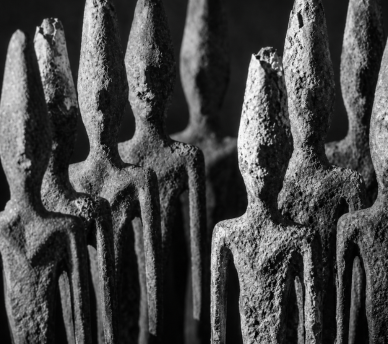
Before Ibiza became a tourist destination, it was an island of small communities connected to the land, the sea and natural resources. Its position in the Mediterranean soon made it a valuable place: remote enough to preserve its own identity, yet connected enough to form part of important maritime routes.
In this early stage, Ibiza began to be shaped by elements that would remain essential for centuries: the sea, salt, coastal settlements and the relationship between landscape and survival. Places such as Sa Caleta and Puig des Molins help us understand that ancient Ibiza that does not appear in the most familiar postcards, but supports much of the island’s historical identity.
The salt flats are also part of this early reading. More than a beautiful landscape, they represent one of Ibiza’s most important historical resources. For centuries, salt was a key economic element and one of the reasons why the island remained relevant within Mediterranean trade routes.
The first inhabitants of Ibiza: the origins of an inhabited island
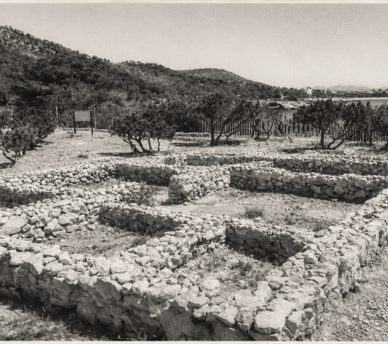
Before Ibiza became a tourist destination, it was an island of small communities connected to the land, the sea and natural resources. Its position in the Mediterranean soon made it a valuable place: remote enough to preserve its own identity, yet connected enough to form part of important maritime routes.
In this early stage, Ibiza began to be shaped by elements that would remain essential for centuries: the sea, salt, coastal settlements and the relationship between landscape and survival. Places such as Sa Caleta and Puig des Molins help us understand that ancient Ibiza that does not appear in the most familiar postcards, but supports much of the island’s historical identity.
The salt flats are also part of this early reading. More than a beautiful landscape, they represent one of Ibiza’s most important historical resources. For centuries, salt was a key economic element and one of the reasons why the island remained relevant within Mediterranean trade routes.
Ancient Ibiza: Phoenicians, Carthaginians, Romans and maritime trade
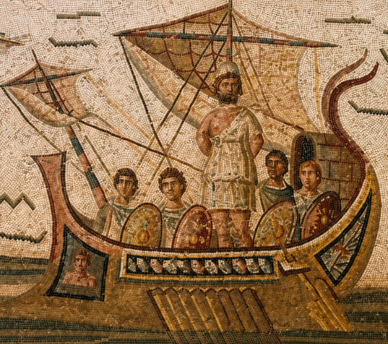
One of the most important chapters in the history of Ibiza is linked to the Phoenicians. Their arrival consolidated the island as a commercial enclave in the western Mediterranean. It was not simply about occupying a territory, but about integrating it into a network of navigation, exchange and production.
Phoenician and Punic influence left a deep mark on the island. Ibiza was not an isolated place: it was part of a Mediterranean world in motion, connected by ships, goods, beliefs, techniques and ways of life. Puig des Molins, for example, helps us understand the funerary and symbolic importance of that ancient Ibiza, while Sa Caleta helps us imagine the direct relationship between settlement, coast and trade.
Later, with the Roman presence, the island became part of another political and economic structure. Forms of administration changed, but Ibiza continued to preserve something that appears throughout its history: its strategic value as a maritime point and its ability to adapt to different cultures without losing its own identity.
Medieval Ibiza: the Islamic period, Catalan conquest and Dalt Vila
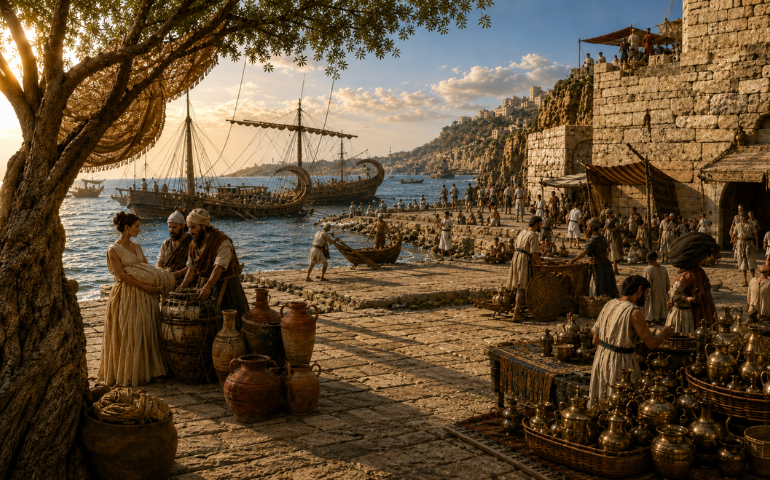
The Middle Ages added new layers to the history of Ibiza. The Islamic period left an important influence on the organisation of the territory, agriculture, water management systems and the way the rural landscape was understood. Ibiza was not only coast: it was also countryside, small communities, inland paths and a very direct relationship with the land.
Later, the Catalan conquest introduced new religious, social and political frameworks. The island entered a new stage, marked by the reorganisation of the territory and the constant need for defence. In this context, the walls and defensive systems became extremely important.
Dalt Vila is the great visible symbol of this historic Ibiza. Its walled profile, sloping streets, gates, bastions and views over the port explain the city’s strategic importance better than many texts. If you want to explore this specific part of the island in more depth, you can read our guide to Dalt Vila, its history and walking route, where we look in more detail at one of Ibiza’s most important heritage sites.
If you visit Dalt Vila at a relaxed pace, you can also extend the plan with lunch or dinner inside the historic quarter. To choose without improvising, you can save our guide to where to eat in Dalt Vila, designed to complete your cultural visit with a well-located gastronomic stop.
Rural Ibiza: farmers, salt, towers and villages
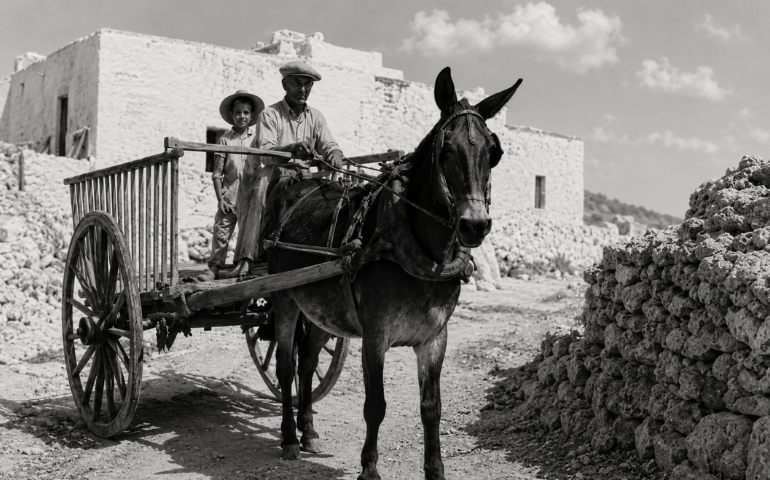
For centuries, Ibiza was above all a rural island. Beyond the walled city and the ports, everyday life was shaped by the countryside, traditional farmhouses, agriculture, livestock, salt, fishing and small settlements.
This rural Ibiza explains much of the local character: a sober, practical way of life, closely connected to nature and to the rhythms of the island. The white houses, stone walls, inland paths and traditional villages are not tourist scenery; they are the visible legacy of a way of life adapted to the climate, isolation and available resources.
During this period, the defence towers also became important. Ibiza had to protect itself for a long time from attacks by sea, and the coastal towers formed part of an essential surveillance system. Today, many of them have become spectacular viewpoints, but their origin responds to a very specific need: to watch the horizon, warn of danger and defend the island.
If you are interested in this more defensive and scenic side of the island, you can extend the route with our route around Ibiza’s defence towers, a highly recommended way to combine history, sea and views.
The villages also help you understand this deeper side of Ibiza. Sant Agustí, Santa Gertrudis, Sant Carles, Sant Joan and Santa Agnès still preserve part of that slower scale, where the island is experienced at a different rhythm. To organise a visit with more meaning, you can read our guide to the most beautiful villages in Ibiza.
This Ibiza of countryside, churches, popular festivals and local life connects naturally with Ibizan traditions, an essential part of understanding the island beyond its tourist image.
Ibiza and the hippy movement: freedom, craftsmanship and another way of life
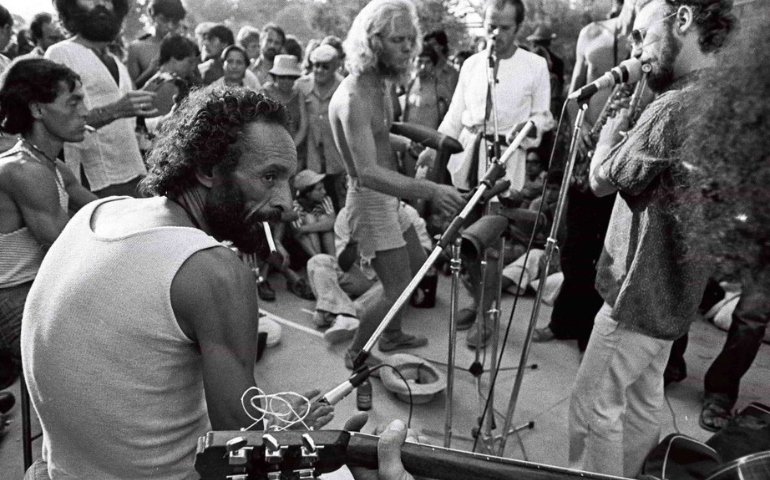
From the 1960s and 1970s onwards, Ibiza began to project a very different image. The island attracted travellers, artists, musicians and alternative communities who found here a freer, simpler and less rigid place than other European destinations.
The hippy movement did not appear in Ibiza by chance. The island offered a rare combination: natural beauty, a relatively peaceful way of life, accessible prices at the time, a Mediterranean landscape, small villages and a certain distance from the major urban norms of the continent. That atmosphere encouraged the arrival of people looking for creativity, community and a different way of living.
Some of the strongest images of Ibiza today were born from that period: craftsmanship, markets, white clothing, open-air music, free spirit and cultural mix. Over time, part of that world became a tourist attraction, but there are still places and markets where that heritage can be felt. To explore it further, you can read our guide to hippy markets in Ibiza.
This sense of freedom is also very present in Adlib fashion, one of the most recognisable expressions of contemporary Ibizan identity. If you are interested in the link between craftsmanship, white clothing, tradition and Mediterranean style, you can read our guide to Adlib fashion in Ibiza.
This period helps explain why Ibiza is still associated with freedom. Not only party freedom, as it is sometimes simplified, but aesthetic, creative, personal and social freedom. That idea remains very present in fashion, decoration, gastronomy, events and the way many travellers imagine the island.
Tourist Ibiza: the first hotels, San Antonio, beaches and European tourism
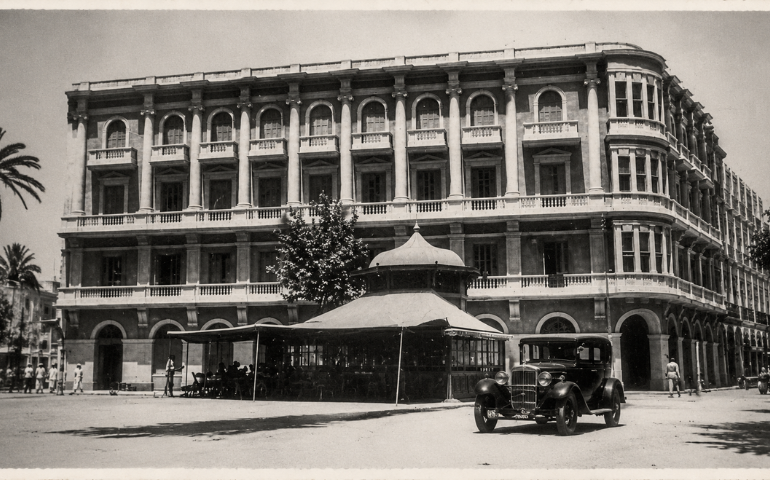
The arrival of tourism changed Ibiza forever. What had long been a rural and relatively isolated island began to become a holiday destination increasingly known among European travellers. The beaches, the climate, the scale of the island and the local hospitality gradually helped build a new economy.
San Antonio played an important role in this transformation. Its bay, maritime connections, sunsets and ability to welcome travellers helped the area become one of the island’s best-known tourist spots. Tourist Ibiza did not appear overnight: it grew in stages, with small accommodation, bars, restaurants, excursions, travelling families, groups of friends and visitors who returned year after year.
If you want to better understand this area as a travel base, you can explore our local guide to what to do in San Antonio, where we bring together beach, sea, sunset and atmosphere plans close to the hotel.
This stage also changed the way people looked at the coast. Beaches stopped being only natural or working spaces and became one of the main reasons for travelling. Coves, sandy beaches, sunsets and swims in clear waters became part of Ibiza’s international identity. If you want to connect that historical side with a current travel plan, you can read our guides to the best beaches and coves in Ibiza and beaches near San Antonio.
Even so, reducing the island to tourism would be too limited. The best way to enjoy it is to combine beaches with culture, villages, gastronomy, routes and small moments of local life. To organise a more complete view of your trip, you can consult our guide to what to see and do in Ibiza.
Ibiza nightlife: clubs, electronic music and club culture
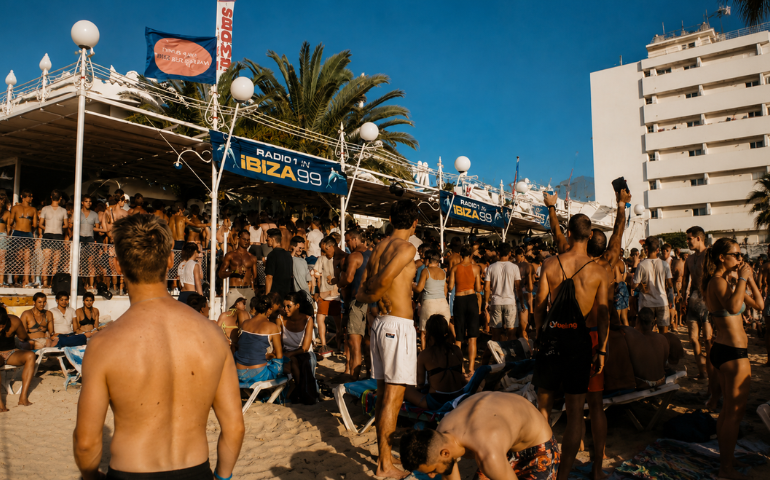
Party culture is another fundamental chapter in Ibiza’s recent history. Over time, the island became one of the world’s great references for electronic music and club culture. Nightclubs, DJs, open-air sessions, beach clubs and international events gradually built a brand recognised around the world.
But partying in Ibiza cannot be understood only as nightlife. It is also part of a musical culture that connected communities, styles and generations. The island was able to blend the free spirit inherited from previous decades with an increasingly professional and global music scene.
If your trip also includes this side of the island, you can plan it better with our guide to the best nightclubs in Ibiza by area and style. And if you are staying in San Antonio, our selection of nightclubs in San Antonio may be especially useful.
This evolution explains why Ibiza has a double image: on one hand, a peaceful, rural and luminous island; on the other, a destination of intense nights, major clubs and international music. That tension between calm and energy is part of what makes it so unique.
Luxury Ibiza: beach clubs, agritourism, restaurants and boutique lifestyle

In recent decades, Ibiza has undergone another transformation: the consolidation of a more sophisticated Ibiza, linked to Mediterranean luxury, gastronomy, beach clubs, agrotourism hotels, signature restaurants, design, wellness and boutique lifestyle.
This kind of luxury is not always expressed in an ostentatious way. Very often, it is more about the experience: sleeping in a charming place, eating well by the sea, discovering a cove without rushing, staying in a convenient area, enjoying personalised service or appreciating a carefully curated Mediterranean aesthetic.
Today’s Ibiza combines many layers at once. You can have breakfast in a small boutique hostal, visit a rural church, swim in a cove, eat fish by the sea, walk through Dalt Vila, watch the sunset on the west coast and end the night in an international club. This coexistence between the traditional and the contemporary is one of the reasons why the island remains so magnetic.
To discover this more contemporary Ibiza from the seaside, you can read our guide to beach clubs in Ibiza. And if you prefer to connect your trip with local flavours, you can also explore our guide to what to eat in Ibiza and traditional dishes.
Places that help explain the history of Ibiza
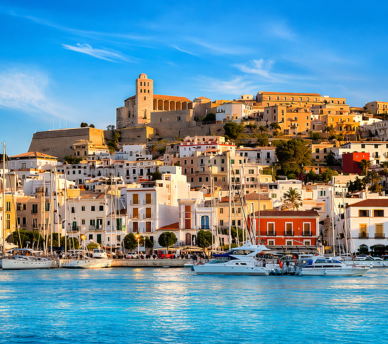
The key is not to see these places as isolated points, but as chapters of the same story. Each one explains a different Ibiza, and together they help you better understand the island today.
Dalt Vila helps you understand the walled, defensive and urban side of Ibiza. Sa Caleta and Puig des Molins connect with ancient and Phoenician Ibiza. The salt flats show the economic and scenic importance of salt. The defence towers explain the island’s historical relationship with the sea and the need for surveillance. The inland villages reveal rural, traditional and payesa Ibiza. The hippy markets, such as Las Dalias, recall the period of creative freedom of the 1960s and 1970s. And areas such as San Antonio help you understand the arrival of tourism and the island’s evolution as an international destination.
The key is not to see these places as isolated points, but as chapters of the same story. Each one reveals a different side of Ibiza, and together they help you better understand the island as it is today.
How to experience Ibiza’s history during your trip

A good way to discover the history of Ibiza is to dedicate part of your trip to stepping away from the most obvious circuit. You can combine Dalt Vila, an inland village, a defence tower, the salt flats or a historic market without turning your holiday into an intense cultural route.
To organise those days with more meaning, our guide to routes around Ibiza can help you connect culture, landscapes and movement by area. If you are going to rent a car, you can also use the driving routes around Ibiza to plan each day better.
From Hostal Rosell Boutique, in the centre of San Antonio, it is easy to organise this kind of island escape. You can move towards beaches, villages, Dalt Vila or inland areas depending on each day’s plan, and then return to a central, practical and peaceful area to rest.
FAQs
What is the origin of Ibiza?
The Pityusic Islands were inhabited before the arrival of the Phoenicians, but Ibiza’s major urban and commercial transformation came with the Phoenician settlements of the 8th-7th centuries BC.
Who founded Ibiza Town?
The town developed from the Phoenician colonisation of the 7th century BC. The later phase is known as Punic and maintained strong connections with Carthage and other Mediterranean networks.
What is Sa Caleta?
It is a Phoenician settlement located in the south of Ibiza and one of the archaeological sites included in the UNESCO World Heritage property.
Why is Puig des Molins important?
It was the necropolis of Ibiza Town throughout Antiquity and preserves thousands of tombs and archaeological finds that help us understand the Phoenician, Punic and Roman periods.
What was Ibiza called during the Muslim period?
The town appears as Madina Yabisa within Al-Andalus. The Islamic period left its mark on fortifications, agriculture and the organisation of the territory.
When was Ibiza conquered by the Catalans?
On 8 August 1235. The conquest opened a new political, religious and social period linked to the Crown of Aragon.


