- 14 July 2025
- Culture, villages and heritage
Dalt Vila, Ibiza: what to see, history and walking route

Dalt Vila (Ibiza): history and guide to discovering the walled city
If you’re planning your trip and wondering what to see in Dalt Vila (Ibiza), this guide is for you: first, a short historical introduction to understand what you’re seeing, followed by a very easy walking route covering the must-see spots (city walls, gates, viewpoints and the cathedral).
To complete your itinerary around Ibiza with more ideas for plans (coves, routes, gastronomy and experiences by area), check our guide to what to see and do in Ibiza.
And if you want to visit it without rushing and return to rest without complications, remember that San Antonio is a practical base for getting around the island. At Hostal Rosell Boutique, your boutique hostel in San Antonio, Ibiza, you’ll enjoy direct-booking benefits (better prices than on booking platforms).
Quick index
Dalt Vila in 2 minutes: why it’s so special
What Is Dalt Vila? | The upper, walled part of Ibiza Town’s historic centre. |
|---|---|
How Much Time Should You Allow? | Aproximadamente dos horas para una visita exterior tranquilaApproximately two hours for a relaxed outdoor visit. |
Where Should You Start? | At Portal de ses Taules, next to La Marina. |
Where Should You Finish? | At Portal Nou or by heading back down towards La Marina. |
What Should You Not Miss? | The city walls, the Parade Ground, Plaça de Vila, the bastions, the cathedral and the viewpoints. |
Do You Need a Map? | It is not essential, although it is useful for following the order of the stops. |
What Is Dalt Vila and Why Is It a World Heritage Site?
The name Dalt Vila means “upper town” and refers to the historic centre located on the hill overlooking the port of Ibiza. Its position made it possible to control access by sea and protect the population living within the fortified enclosure.
The appearance we see today is the result of different historical periods, which you can explore in greater detail in our guide to the history of Ibiza. The urban layout preserves elements linked to the earliest settlements, the Islamic period, the Catalan conquest and the great Renaissance fortifications.
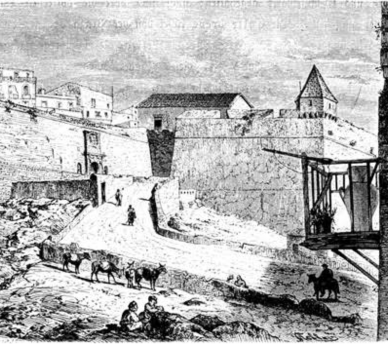
Dalt Vila Before the Renaissance Walls
The history of the site began long before the current bastions were built. The city grew and evolved within the same area, incorporating streets, buildings and defensive systems from successive periods.
The Andalusian period left a particularly significant mark on the layout of the medieval city. Part of this period can be explored at the Madina Yabisa interpretation centre, located near Cathedral Square.
After the Catalan conquest of 1235, new religious, civil and defensive buildings were introduced, but the urban centre continued to make use of much of the previous structure.
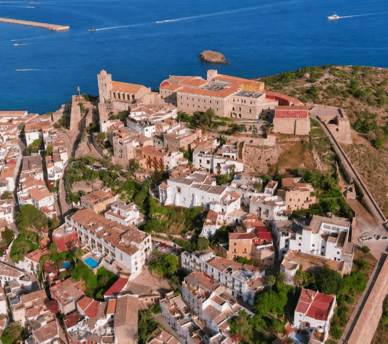
The 16th-Century Fortifications
During the 16th century, Ibiza strengthened its defences with a system of walls and bastions adapted to new forms of warfare and the use of artillery.
The enclosure no longer relied solely on vertical walls and came to include large bastions capable of controlling different angles of the surrounding terrain. The result is a fortification that still makes it possible to understand the scale and logic of Renaissance military architecture.
UNESCO considers the fortifications of Ibiza an exceptional example of Renaissance military engineering and highlights the preservation of the different historical periods within the upper town.
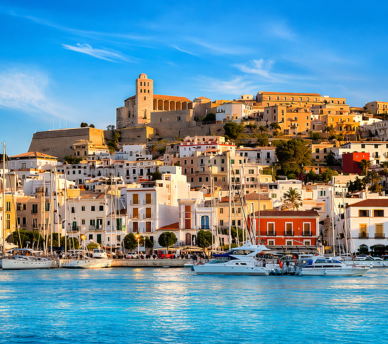
The UNESCO Declaration
Dalt Vila and its walls form part of the mixed World Heritage property “Ibiza, Biodiversity and Culture”, declared a World Heritage Site in 1999.
The declaration does not include only the walled enclosure. It also links Dalt Vila with the Puig des Molins necropolis, the Phoenician settlement of Sa Caleta and the natural values associated with the seagrass meadows.
This combination makes it possible to understand Ibiza as a territory where the landscape, its maritime position and the different cultures that occupied the island are closely connected.
Walking route through Dalt Vila (easy itinerary, 1–2 hours)
This route is designed for visitors who want to see the essentials and get the best photos, without turning it into an endless walk. Set your own pace: the beauty here is in stopping.
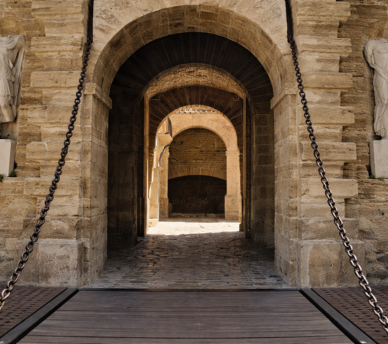
1. Portal de ses Taules
Your ideal entrance is Portal de ses Taules, the main gateway to the walled enclosure. It is located between bastions and was built between 1584 and 1585.
This is usually where the classic photo is taken: the monumental entrance, the bridge and the initial climb that immediately sets the atmosphere.
After passing through the gateway, you will enter directly into the Parade Ground.
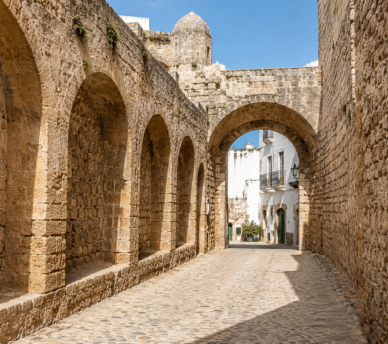
2. Parade Ground and Plaça de Vila
The Patio de Armas is one of the most recognisable spaces at the beginning of the route. Its arched gallery creates a transition between the monumental entrance and the inner streets.
After crossing it, you will reach Plaça de Vila, a former market area and one of the liveliest spots within the walls. Today, it is home to small shops, galleries, terraces and several access points leading to the upper part of Dalt Vila.
Instead of heading directly up towards the cathedral, continue first towards Sa Carrossa. From there, you can approach the Baluard de Santa Llúcia and enjoy one of the best views of the port.
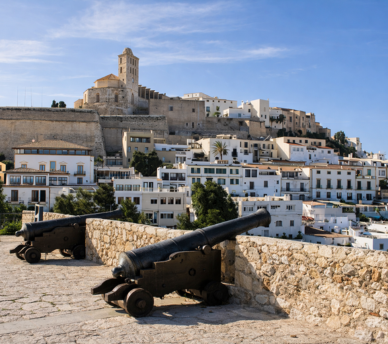
3. Sa Carrossa and Baluard de Santa Llúcia
La place de sa Carrossa relie les rues intérieures à la partie orientale des remparts. De là, vous pourrez accéder au Baluard de Santa Llúcia, l’un des espaces les plus vastes de l’enceinte fortifiée.
Inside the bastion is es Polvorí, a former artillery storehouse now used as a cultural or exhibition space, depending on the current programme.
After enjoying the views, continue along Calle General Balanzat towards the Church of Santo Domingo.
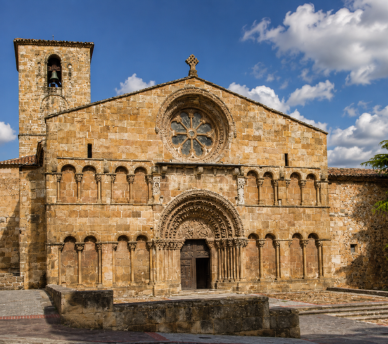
4. Church of Santo Domingo and Town Hall
The Church of Santo Domingo forms part of the former Dominican convent complex. Its presence marks one of the main religious and administrative areas of Dalt Vila.
Next to the church is Plaça d’Espanya, along with part of the municipal offices. From this area, you can also enjoy different views of the port and the outer side of the walls.
5. Madina Yabisa and Cathedral Square
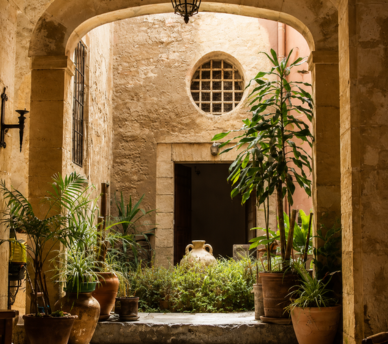
At the top of Calle Major is the Casa de la Curia, home to the Madina Yabisa Interpretation Centre.
This space helps visitors understand the city during the period of Islamic rule and the importance of its urban structure in the subsequent development of Dalt Vila.
A few steps away lies Cathedral Square, home to some of the most important buildings in the upper town. It is also one of the best places to stop and rest after the climb.
6. Walls, Bastions and Exit through Portal Nou
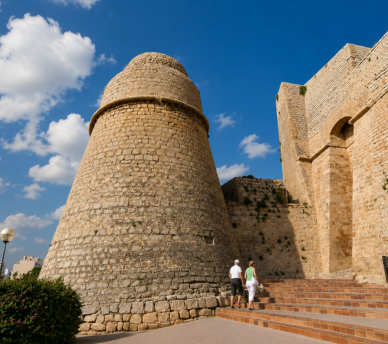
From Cathedral Square, you can begin the descent by following part of the perimeter of the walls.
The route passes around the castle and allows you to visit several bastions, such as Sant Bernat, Sant Jordi, Sant Jaume and Sant Pere, depending on the path you choose to follow.
To complete a circular route, you can finish at Portal Nou. This exit connects the walled city with Reina Sofía Park and the Vara de Rey area.
How to Get to Dalt Vila
Dalt Vila is located in the historic centre of Ibiza Town. Although the fortified enclosure can be seen from different points around the port, its most iconic entrance is Portal de ses Taules, which is accessible from La Marina.

By private transfer from Hostal Rosell Boutique
Guests staying at Hostal Rosell Boutique can request a private transfer to Ibiza Town, a convenient option for getting there without depending on bus timetables or having to look for parking. The service can drop you off near La Marina, Vara de Rey or Reina Sofía Park, from where you can continue on foot to Portal de ses Taules.

By bus or taxi
By bus, the most practical option is to travel to the centre of Ibiza Town and complete the final stretch on foot towards La Marina and Portal de ses Taules.
Routes and frequencies may vary depending on the departure point and the time of year, so it is advisable to check the current service for the date of your visit.

By car and where to park
It is not advisable to plan your visit with the intention of driving into the historic centre. The most practical option is to park outside the walled area and continue on foot.
The choice of parking will depend on whether you want to start your visit from La Marina, Vara de Rey, the port or the Reina Sofía Park area.
To compare the available options, read our guide on where to park when visiting Dalt Vila.
Tips for Visiting Dalt Vila
Avoid the Middle of the Day on the Hottest Days
Dalt Vila combines steep slopes, stone-paved streets and areas exposed to the sun, so the climb can be more demanding during the middle of the day. Early in the morning, you will find a quieter atmosphere, while temperatures are usually more pleasant in the late afternoon and the viewpoints offer particularly attractive light over the port.
Wear Comfortable Footwear
The cobbled streets are part of the historic quarter’s charm, but the slopes, steps and bastions can be uncomfortable when wearing unstable footwear. It is best to wear well-fitting trainers or sandals that allow you to walk more comfortably and safely throughout the route.
Bring Water and Explore Dalt Vila at a Relaxed Pace
Although the total distance is not particularly long, the visit is more enjoyable when you can stop at the viewpoints, explore a square or take a detour along a side street. Bring water, especially during the summer, and allow enough time for short breaks without having to complete the route too quickly.
What to Do After Visiting Dalt Vila
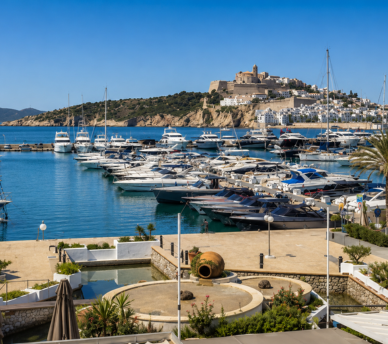
After finishing your visit, you can head down towards La Marina and explore the streets near the port. Vara de Rey and Plaça des Parc are also nearby and offer a different atmosphere from the walled city.
To continue exploring the capital, you can combine your visit with the port, the Puig des Molins necropolis or a walk through Figueretas, depending on the time available.
You can also read our guide on where to eat in Dalt Vila if you would like to finish the route with lunch, dinner or a drink on a terrace within the historic quarter.
To include Dalt Vila in a broader itinerary around the island, you will find more ideas in our guide to what to see and do in Ibiza.
Dalt Vila from San Antonio: the most convenient plan
If you’re staying in San Antonio, you can enjoy a day with a great rhythm: a morning of beach or relaxation, a cultural afternoon in Ibiza Town, and then head back to sleep in a practical and quiet area.
If you’re looking for a base with great value for money and direct-booking benefits, book at Hostal Rosell Boutique, your boutique hostel in San Antonio, Ibiza: best direct price and clear conditions to organise your stay with ease.
FAQs
Can You Visit Dalt Vila for Free?
The streets, squares and much of the outdoor route can be explored on foot. Some museums, interpretation centres and indoor spaces have their own admission conditions.
Does Dalt Vila Have Many Slopes?
Yes. The visit includes slopes, cobbled streets and some flights of steps. It is advisable to wear comfortable footwear and avoid the middle of the day during the hottest days.
What Is the Best Time to Visit Dalt Vila?
Early morning and late afternoon are usually the most comfortable times to visit. At sunset, the bastions and viewpoints offer beautiful views over the port and the city.
Is Dalt Vila Worth Visiting at Night?
Yes. The illuminated walls and streets create a different atmosphere from a daytime visit. However, it is advisable to complete at least part of the route during daylight to better appreciate the architecture and views.
Can You Enter Dalt Vila by Car?
Vehicle access is restricted in several areas. For a sightseeing visit, the most practical option is to park outside the historic quarter and continue on foot.


